
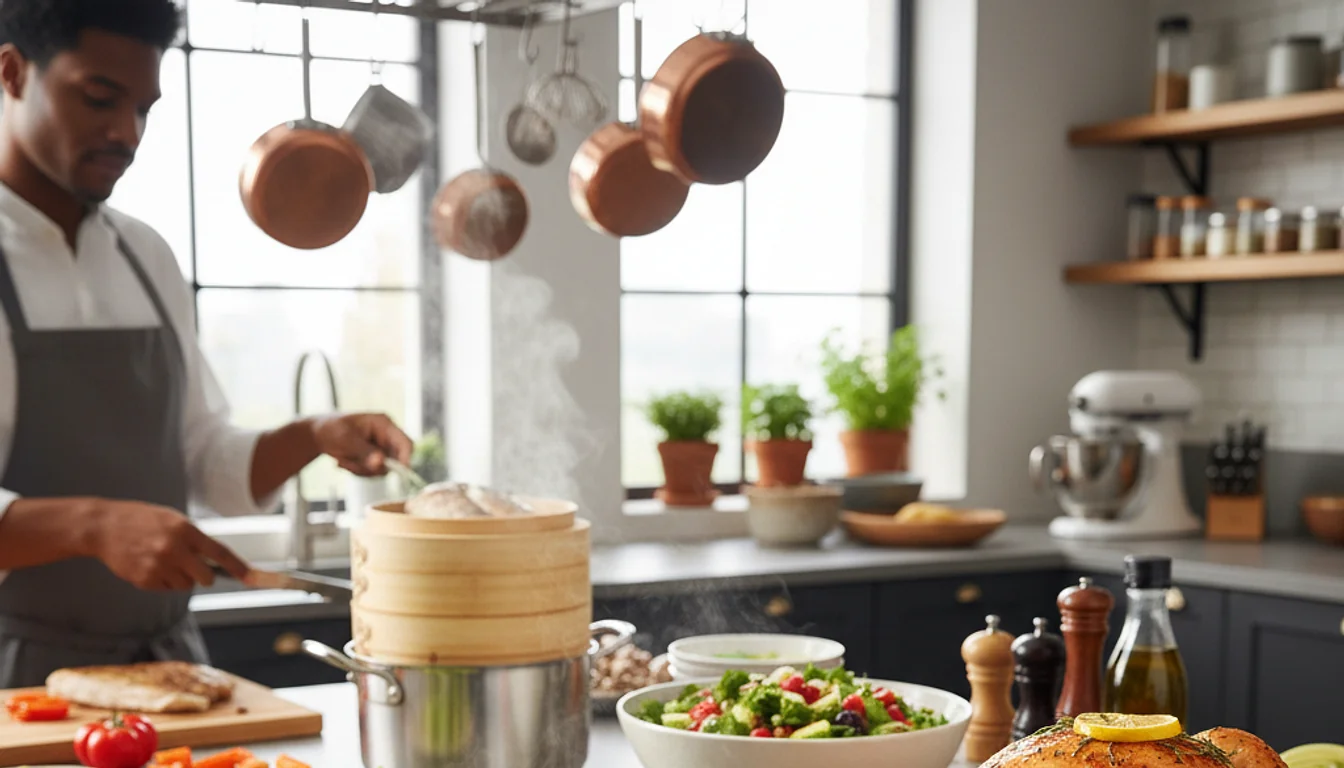
healthy cooking methods - relevant illustration

Healthy Cooking Methods: The 5 Kitchen Shifts That Saved My Energy (and My Gut)

7 minutes, 25 seconds Read
← Scroll to see more →

Feature Details

Quick Summary
Healthy cooking methods are techniques that preserve a food’s nutritional profile while minimizing the creation of inflammatory toxins.

, or high-speed methods like stir-frying, you can reduce your intake of harmful compounds while maximizing vitamins.

My top recommendation for 2026. Invest in a quality ceramic pan and master the art of the “water sauté.

88% of people have no idea what they’re doing with healthy cooking methods . To be honest, I was one of them.

Back in 2021, when I was still grinding 60 hours a week in a windowless corporate office in Downtown L.A., my idea of “healthy” was a blackened salmon salad that was basically charred to a crisp. I thought if it was fish, it was good.

I didn’t realize that the way I was preparing it—high heat, oxidizing oils, and deep charring—was actually fueling the chronic inflammation that kept me in a state of perpetual burnout.

Now that I’m a certified nutritionist living in Santa Monica, I spend my mornings at the Wednesday Farmers Market on Arizona Avenue picking up $8.00 bunches of organic heirloom carrots.

heal me. Transitioning to ; it’s about the chemistry of the heat you apply to it.

[DEFINITION] Healthy Cooking Methods
Culinary techniques that use temperature control

Feature
Details

I remember sitting in my nutritionist certification class, looking at a chart of AGE levels in boiled chicken vs.

The fried version had nearly 10 times the inflammatory markers. It was a lightbulb moment.

If you’re trying to heal your gut or your hormones, the “how” is just as vital as the “what.

📊 Steaming broccoli preserves 80% of its Vitamin C, whereas boiling reduces it to just 33% due to leaching — Source

Journal of Food Quality and Preference
, 2024

The Danger of “Healthy” Fats at High Heat

One of the biggest mistakes I see my Santa Monica clients make is using extra virgin olive oil for everything. I love a good $34.00 bottle of Brightland oil as much as the next person, but if you use it for high-heat searing, you reach its smoke point.

Once an oil smokes, it oxidizes, creating free radicals. For healthy cooking methods, you need to match the oil to the temperature.

//www.nourishedlivingtoday.com/wp-content/uploads/2026/04/healthy_cooking_methods_7.webp” alt=”healthy cooking methods – relevant illustration” />

2. Steaming and Poaching

The Gentle Giants

Feature Details
I started //www.nourishedlivingtoday.com/2023/06/07/poaching-a-delicate-cooking-technique-for-tender-proteins/” rel=”noopener noreferrer”>poaching salmon in a mixture of coconut milk and ginger back in 2023
, and it changed my life. No more dry, fishy-smelling kitchen. Just melt-in-your-mouth fat that actually feels like medicine. I usually buy my wild-caught sockeye from the Santa Monica Seafood Market—it’s about $28.99 a pound, but because I’m poaching it, none of that expensive nutrition is lost to the pan.

💡 Pro Tip When steaming vegetables, add aromatics like lemon zest or smashed garlic to the water. The steam carries the flavor into the food without needing extra salt or oils.

The “Water Sauté” Trick

To be honest, I don’t always use oil to start my veggies. A trick I learned is the water sauté.

You put two tablespoons of water or veggie broth in the pan, get it bubbling, and toss in your onions. It softens them perfectly without the risk of oxidizing fats.

Once the heat is off, I drizzle the oil on top for flavor and nutrient absorption. It’s a total turning point for digestion.

3. Stir-Frying

Speed is Your Best Friend

When you do need heat, keep it fast. //www.

nourishedlivingtoday. com/2023/06/17/stir-frying-quick-and-nutritious-meals-in-minutes/” rel=”noopener noreferrer”>Stir-frying is a brilliant healthy cooking method because the food spends very little time in the pan.

This minimizes nutrient loss while giving you that “crunch” that makes eating vegetables actually enjoyable.

Last Tuesday, I made a 10-minute stir-fry using a $119.00 Made In Stainless Steel Wok I bought last year. I used avocado oil (high smoke point.

) and kept the veggies moving. The result.

Bright green snap peas that still had all their enzymes. If I had roasted those for 30 minutes, they’d be brown mush with half the nutritional value.

[COMPARISON_TABLE] | Method | Max Temp | Nutrient Retention | Best For | |

— |

Feature
heal me.

Feature
//www.nourishedlivingtoday.com/wp-content/uploads/2026/04/healthy_cooking_methods_7.webp” alt=”healthy cooking methods – relevant illustration” />

2. Steaming and Poaching

Roasting: The 2026 Reality Check

← Scroll to see more →

Feature Details
Is the air fryer actually a “healthy” cooking method. Mostly, yes.

It’s essentially a high-powered convection oven that uses air to mimic the crispiness of deep frying. According to a 2025 review in Nutrients, air frying can reduce acrylamide formation by up to 90% compared to traditional deep frying.

I use my Ninja Foodi (I think I paid $169.99 at Target on 26th St) at least four times a week. However, there is a downside.

Because it’s a dry heat method, you can still overcook things. I’ve found that if I go over 375°F, my chicken gets that “tough” texture which indicates denatured proteins that are harder to digest.

⚠️ Warning

Avoid using aerosol “non-stick” sprays in your air fryer or pans. They often contain soy lecithin and propellants that can damage the coating of your cookware and add unnecessary chemicals to your food.

The Roasting Mistake

I used to roast everything at 425°F because I wanted that char. Now.

I stay at 350°F or 375°F. It takes 10 minutes longer, but the flavor is deeper, and I’m not creating those nasty AGEs.

It’s about being patient with your health.

If you’re constantly rushing your cooking, you’re likely rushing your stress response too. I talk about this a lot in my guide on
//www.

nourishedlivingtoday. com/2026/03/18/which-wellness-tips-tricks-are-actually-worth-your-time-my-2026-no-bs-guide/” rel=”noopener noreferrer”>wellness tips that aren’t a waste of time.

5. The Cookware Factor: Don’t Poison Your Process

Feature
Details

You can use the best healthy cooking methods in the world, but if you’re using a scratched Teflon pan from 2012, you’re leaching PFAS (per- and polyfluoroalkyl substances) into your dinner.

//www.nourishedlivingtoday.com/wp-content/uploads/2026/04/healthy_cooking_methods_19.webp” alt=”healthy cooking methods – relevant illustration” />

Instead, I invested in a Caraway Ceramic Set. It was a splurge at $395.00, but I’ve used the sauté pan every single day for two years and it’s still perfect. Ceramic is naturally non-stick and doesn’t off-gas toxic fumes at higher temperatures.

[COST_COMPARISON] Cheap Teflon Pan

$25.00
, lasts 6 months (toxic) | Quality Ceramic Pan $95.

Feature
//www.nourishedlivingtoday.com/wp-content/uploads/2026/04/healthy_cooking_methods_19.webp” alt=”healthy cooking methods – relevant illustration” />

Instead, I invested in a Caraway Ceramic Set. It was a splurge at $395.00, but I’ve used the sauté pan every single day for two years and it’s still perfect. Ceramic is naturally non-stick and doesn’t off-gas toxic fumes at higher temperatures.

[COST_COMPARISON] Cheap Teflon Pan

Details
$25.

Feature
, lasts 6 months (toxic) | Quality Ceramic Pan
Details
$95.00

My Daily Essentials

💡
Stainless Steel
← Scroll to see more →

Feature Details
Best for searing (if you must) and longevity. I use the 12 inch All
💡
Cast Iron

Great for iron absorption, but high maintenance. I use my Lodge skillet ($29.90) for Dutch babies and occasional steaks.

💡
Glass or Bamboo Steamer

Essential for the “gentle” methods. A bamboo steamer costs about $18.00 and fits over any pot you already own.

The Step-by-Step Path to a Healthier Kitchen

1

Audit your oils

Switch to Avocado oil for heat and save the Olive oil for dressings.

2

Try one “wet” meal a week

Replace one roasted meal with a poached or steamed meal. See how your digestion feels the next morning.

3

Lower the dial

Try cooking your favorite meal 25 degrees lower than usual. It takes longer, but the moisture retention will surprise you.

4

Ditch the char

If it’s black, it’s likely inflammatory. Aim for golden brown at most.

So yeah. That’s what I wish I knew back when I started.

It wasn’t about eating “clean” in some restrictive, miserable way. It was about learning the language of heat.

Once you realize that the way you cook is an act of self-care, everything changes. My energy is higher at 36 than it ever was at 26, and I truly believe my kitchen habits are 70% of that equation.

✅ Key Takeaways

  • Prioritize moisture-based methods like steaming and poaching for maximum nutrients. – Keep “dry” methods like stir-frying fast to minimize chemical changes in food.
  • – Use oils with high smoke points (avocado, ghee) for any heat-based cooking. – Switch to ceramic or stainless steel cookware to avoid leaching toxins.- Lower your oven temperature to 350-375°F to reduce inflammatory AGEs.

Key Takeaways

  • Apply these insights to your specific situation
  • Apply these insights to your specific situation
  • Apply these insights to your specific situation

1.5rem
;display flex
;align-items center
;gap 0.5rem
;”>1.25rem
;”>💬 Frequently Asked Questions
Actually, from my experience and research, no. Because microwaving is very fast and uses minimal water, it can actually preserve more Vitamin C than boiling. I use it for a quick “steam” of frozen peas when I’m in a rush. Just make sure you’re using glass, never plastic, to avoid chemical leaching.
For high-heat healthy cooking methods, I always reach for Avocado oil. It has a smoke point of around 520°F. For medium heat, I use Grass-fed Ghee ($14.47 at Whole Foods). I never use vegetable, canola, or soybean oil because they are highly processed and prone to oxidation.
The “bland” reputation of steaming is just bad PR. I always finish my steamed veggies with a “flavor pop”
a squeeze of fresh lime

Feature
Best for searing (if you must) and longevity. I use the 12
Details
inch All

Feature
1.5rem

Feature
;display
Details
flex

Feature
;align-items
Details
center

Feature
;gap
Details
0.5rem

Feature
;”>
Details
1.25rem

Feature
;”>💬 Frequently Asked Questions
Actually, from my experience and research, no. Because microwaving is very fast and uses minimal water, it can actually preserve more Vitamin C than boiling. I use it for a quick “steam” of frozen peas when I’m in a rush. Just make sure you’re using glass, never plastic, to avoid chemical leaching.
For high-heat healthy cooking methods, I always reach for Avocado oil. It has a smoke point of around 520°F. For medium heat, I use Grass-fed Ghee ($14.47 at Whole Foods). I never use vegetable, canola, or soybean oil because they are highly processed and prone to oxidation.
The “bland” reputation of steaming is just bad PR. I always finish my steamed veggies with a “flavor pop”
Details
a squeeze of fresh lime

Similar Posts