

| Feature | Details | |
|---|---|---|
|
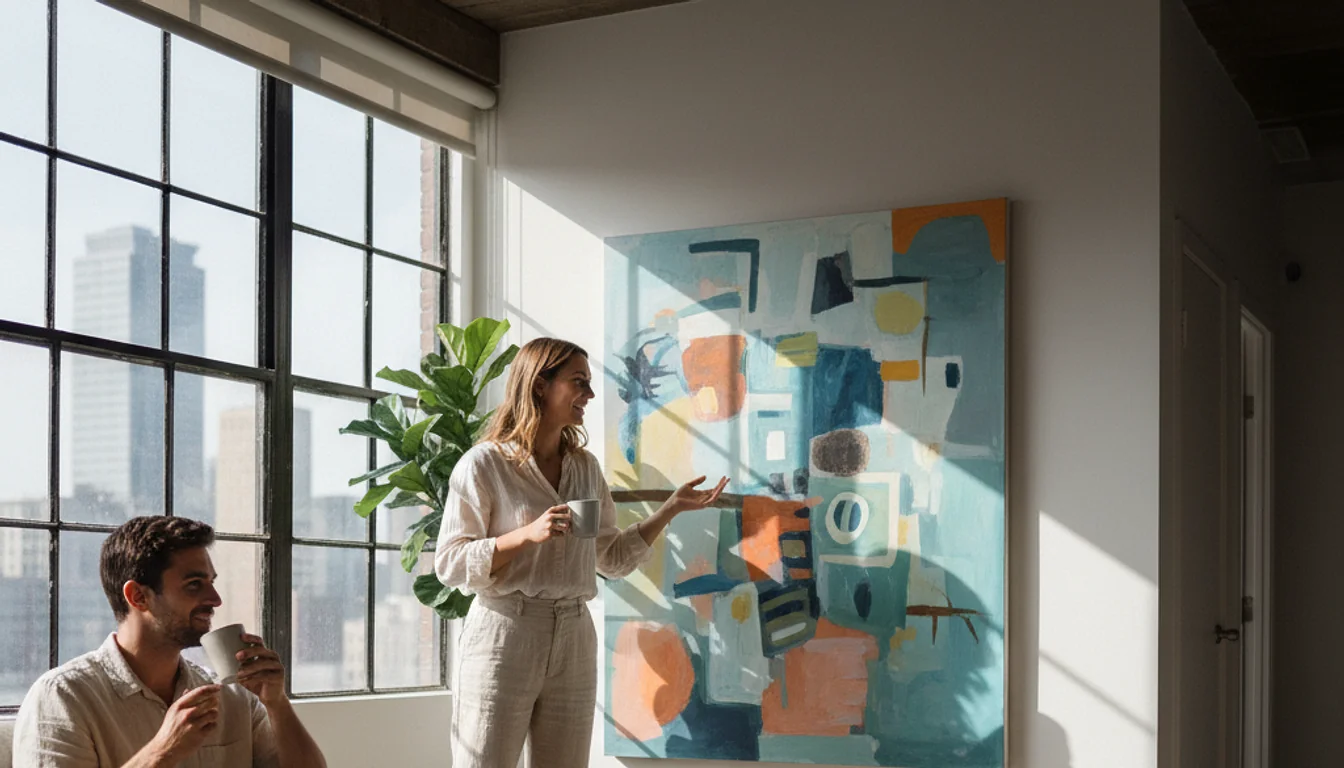
📖 Definition Abstract art is a non-representational style of visual art that uses shapes, colors, forms, and gestural marks to achieve its effect rather than depicting an accurate representation of visual reality. For those of us dealing with high-stress lives, abstract art serves as a visual “reset button” for the nervous system, allowing the brain to move away from rigid logic and into a state of creative flow and emotional processing. Picture this , completely overwhelmed by abstract art options. I was at a West Elm in Santa Monica back in November 2024, staring at a canvas that looked like a blue explosion. My head was throbbing—a remnant of the chronic pain that forced me out of my VP role—and I kept asking myself, “Is this actually art, or am I just paying for someone’s weekend experiment. ” I felt ridiculous. Quick Summary: My head was throbbing—a remnant of the chronic pain that forced me out of my VP role—and I kept asking myself, “Is this actually art, or am I just … I’m a nutritionist, not a critic. But I was desperate for anything that would make my living room feel like a sanctuary instead of a reminder of my former, frantic life. To be honest, I bought that first piece for $142.50 mostly because the colors matched my throw pillows. that said,, that “impulse buy” changed how I viewed my entire recovery. It wasn’t about the painting; it was about how my brain finally stopped trying to “label” everything. In the world of corporate spreadsheets, everything has a box. In abstract art, there are no boxes. That’s where the healing begins.
🔗 Affiliate Disclosure
|
Why Mass-Produced Art Often Fails to Heal
I learned the hard way that not all abstract art is created equal. That first piece I bought. It was a mass-produced print. After three weeks, it started to feel. empty. To be honest, it felt like looking at a screensaver. It lacked the energy of something a human actually touched. //www.nourishedlivingtoday.com/wp-content/uploads/2026/04/abstract_art_8.webp” alt=”abstract art – relevant illustration” />
|
|
I realized that for art to be a tool for healing, it needs texture and intention. If you’re looking for a quick fix, you might be tempted by the $20 prints at big-box stores. But I found that those often contribute to “visual clutter” rather than “visual peace.” In my
| Feature | Details | ||
|---|---|---|---|
|
⚠️ Warning |
Avoid “trend-chasing” art. If you buy a piece just because it’s the “it” color of 2026 | ||
| , you’ll likely grow tired of it within six months, adding to your mental load rather than subtracting from it.
I eventually sold that first print at a garage sale for $15 and felt a weird sense of relief. It taught me that my environment is an extension of my nervous system. If the art is “fake,” my brain knows it. I started looking for pieces with visible brushstrokes and “imperfections. ” That’s where the real connection happens. How to Choose Art That Actually Lowers Your StressSo, how do you actually pick something. If you’re like me, you might feel like an imposter in a gallery. Don’t. You are the only expert on what makes you feel calm. When I’m helping my nutrition clients with their environments, I use what I call the “Five-Second Gut Check. “ The Five-Second Gut Check
Step 1Stand in front of the piece.
2
Step 2Take a deep breath.
3
Step 3Notice where your shoulders are. Did they drop? Or did they hike up toward your ears?
4
Step 4Ignore the price and the artist’s name for a moment.
5
Step 5If you feel a “release” in your stomach, that’s your piece. I used this method at a small pop-up gallery last March. I found a small 8x10 canvas that was mostly white with one single, aggressive red line through the middle. My logical brain said, “That’s ugly. ” But my gut felt a strange sense of validation. It looked how my burnout felt—quiet, but with a hidden scream. I bought it for $65.00 and it’s now the most grounding thing in my bedroom. 💡 Pro Tip Look for “High-Texture” pieces. Research from the University of Westminster in 2025 suggests that art with physical depth (thick paint, mixed media) engages the brain more effectively than flat images, promoting deeper relaxation. Key Takeaways
The Cost of Connection |
Budgeting for Art in 2026
You don’t need to be a millionaire to own meaningful abstract art. Actually, some of my favorite pieces cost less than a fancy dinner in Santa Monica. that said,, you do get what you pay for for “emotional resonance.” It was raw and vibrant. Compare that to the “luxury” decor stores where you’ll pay $300 for something that 5,000 other people also have. If you’re already working on nourishedlivingtoday. com/. p=2648″ rel=”noopener noreferrer”>my no-bs guide to weight control , you know that quality always beats quantity. The same applies to your walls. //www.nourishedlivingtoday.com/wp-content/uploads/2026/04/abstract_art_17.webp” alt=”abstract art – relevant illustration” />
|
[PRODUCT_BOX name=”Liquitex Heavy Body Acrylics” price=”$23.47″ link=”https I used to think art belonged over the sofa. That’s fine for guests, but for you , it needs to be where your eyes land when you’re stressed. I have a small, chaotic abstract piece right next to my coffee maker. Why. Because 7 AM is when my “to-do list” brain starts screaming. Seeing those unorganized splashes of color reminds me that life doesn’t have to be perfect to be beautiful. It’s a subtle nudge to stay in the present moment.
Choose “Low-Contrast” pieces. Think blues |
|
| , greens, and soft greys. You want your brain to “fade out,” not “wake up.”
|
Choose “High-Energy” pieces. Bold yellows or oranges can help stimulate creativity when you’re hitting a wall. | ||
|
|
This should be your “Transition” piece. Something that signals to your brain | ||
|
I remember one specific evening, about six months into my recovery. I was doomscrolling at 1 AM—a terrible habit I’ve since mostly broken—and I looked up at the wall. The moonlight was hitting a textured piece I’d hung across from my bed. The shadows made the abstract shapes move slightly. It was so much more interesting than the screen. I put the phone down and actually slept. The answer was right there the whole time. ✅ Key Takeaways
From my experience, you’ll know it’s working when you find yourself “staring into” the piece without realizing time has passed. In clinical terms, this is a “flow state.” Personally, I noticed my breathing slowed down whenever I looked at my favorite blue abstract piece for more than 30 seconds. If you feel more agitated or find yourself trying to “figure out” what it represents, it might be too busy for your current stress level.
This happened with my husband! To be honest, I just stopped trying to convince him it was “good art” and told him it was “mental health equipment.” Once I framed it as something that helped my chronic pain and burnout, he was much more supportive. We eventually found a middle ground with “Geometric Abstraction,” which feels more organized to a logical brain but still offers the color-therapy benefits I need.
I suggest a range of $150 to $400 for a medium-sized original piece from an emerging artist. Back in April 2026, I saw prices for high-quality student work starting around $120.00. If that feels steep, remember the “cost per use.” If you look at it every day for 10 years, a $300 painting costs you about 8 cents a day. That’s way cheaper than the $12k I saved by //www.nourishedlivingtoday.com/2026/04/09/i-stopped-ordering-delivery-how-simple-nutritious-meals-saved-my-health-and-12k/” rel=”noopener noreferrer”>stopping delivery orders!
Absolutely. While it’s subjective, a 2025 study from the University of Sussex found that “Cooler” tones (blues/greens) are more effective for anxiety reduction, while “Warmer” tones (reds/yellows) can help with depressive symptoms of burnout. I personally keep a vibrant orange piece in my workout area to keep my energy up, but my “healing corner” is strictly muted earth tones and soft whites.
|