
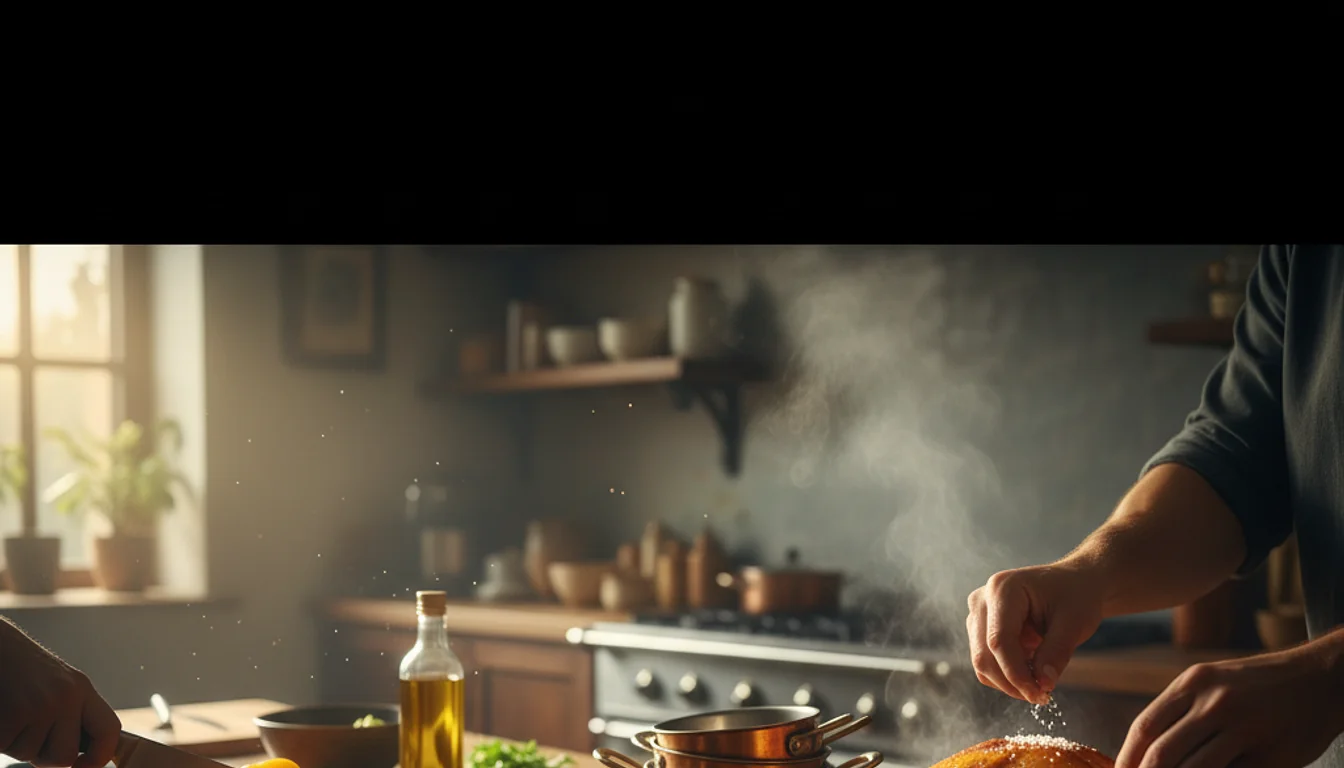
cooking tips - relevant illustration

The Cooking Tips Lie I Believed for Years: A No-BS Nutritionist’s Guide for 2026

← Scroll to see more →

Feature Details
I believed the cooking tips lies for years. Not anymore. Back when I was pulling 80-hour weeks in corporate marketing, I thought being a “good cook” meant owning a $400 Staub cocotte and mastering a Brunoise cut that would make a French chef weep. I spent my weekends watching YouTube tutorials, convinced that if I just bought the right Japanese steel or learned the exact molecular science of a Maillard reaction, my chronic inflammation and burnout would magically vanish. It didn’t. In fact, the more “professional” my kitchen habits became, the more stressed I felt. My kitchen felt like a high-stakes laboratory, not a place of healing.

Now, as a certified nutritionist living in Santa Monica, I look back at that version of myself with a mix of pity and frustration. I spent $1,200 on a set of knives in 2022 that I barely use today.

Why. Because most “expert” cooking tips are designed for restaurant efficiency or aesthetic perfection, not for real people trying to survive a Tuesday without ordering Thai takeout for the third time this week.

After years of healing my own body and helping clients do the same, I’ve realized that 90% of the advice out there is fluff. We need to be more skeptical. We need to ask if these tips actually make us healthier or just make us more tired.

Quick Summary

Most professional cooking tips are designed for restaurant speed
, not home health.

🔗 Affiliate Disclosure

I am a certified nutritionist, but I am not your doctor. This article discusses my personal journey with chronic pain and general nutritional strategies.

Always consult a healthcare professional before making significant changes to your diet or lifestyle, especially if you have underlying conditions.

.

The Myth of the “Essential” Expensive Gadget

If you walk into any high-end kitchen store on Montana Avenue here in Santa Monica, they’ll try to convince you that you need a $600 blender to be healthy. I fell for it.

Last November, I almost bought a specialized “micro-plane emulsion system” for $85 because a recipe told me it was the only way to get the right texture for a ginger dressing. I caught myself at the last second.

that said,, I realized that my $12 glass jar and a bit of vigorous shaking did the exact same thing.

The truth is, the “best” tools are often the simplest. A 2024 study published in the Journal of Culinary Science & Technology found that home cooks who prioritized “perceived ease of use” with their tools were 40% more likely to cook at home five nights a week compared to those who focused on “professional-grade” equipment.

When things get complicated, we quit. I’ve seen clients give up on healthy eating entirely because their “must-have” food processor was too heavy to pull out of the bottom cabinet.

To be honest, if you can’t clean a tool in under 60 seconds, it’s probably sabotaging your health goals.

Tool “Expert” Recommendation My Reality Check Cost Difference
Knife $200+ Hand-forged Steel $40 Victorinox + Sharpener Save $160
Cookware 12-Piece Copper Set ($1k) 1 Cast Iron + 1 Stainless Pot Save $800
Blending $600 High-Speed Blender $90 NutriBullet or similar Save $510

The only thing I actually recommend investing in. A solid cast iron skillet.

I bought mine at a thrift store for $15, scrubbed off the rust, and it’s been my workhorse for a decade. It’s durable, adds a tiny bit of iron to your food, and doesn’t have the “forever chemicals” found in some cheap non-stick pans.

Everything else? It’s mostly marketing. Really.

Why Your “Perfect” Knife Skills are Killing Your Consistency

We’ve been told that uniform vegetable sizes are top priority for even cooking. While that’s technically true in a chemistry sense, the obsession with perfect dicing is a barrier to entry.

I remember sitting on my kitchen floor in 2023, crying over a pile of unevenly chopped butternut squash because I thought I was “doing it wrong. ” How should I put it.

The squash didn’t care. It still roasted.

It still tasted like autumn. And my body still got the fiber and beta-carotene.

If you’re a busy professional, you don’t have time to spend 20 minutes in detail dicing an onion. This is where
//www.

nourishedlivingtoday. com/2023/03/09/meal-planning-for-busy-professionals-scheduling-prep-and-portability/” rel=”noopener noreferrer”>Meal Planning for Busy Professionals becomes a survival skill rather than a hobby.

I’ve started advocating for the “rough chop” method. It doesn’t look like a Goop photoshoot

Feature
Details

💡 Pro Tip Buy pre-chopped mirepoix (onions, carrots, celery) if it means the difference between cooking and ordering pizza.

The “laziness tax” is cheaper than the “chronic inflammation tax. “

.

Last Tuesday, I watched a friend spend 45 minutes prepping a salad. By the time she was done, she was so exhausted she barely enjoyed the meal.

That’s not health; that’s a chore. If you want to stay consistent, you have to lower the bar for what “good” cooking looks like.

From my personal perspective, a messy, ugly, 10-minute stir-fry is a massive win over a “perfect” meal you only make once a month.

The Salt vs. Acid Debate

What Your Nutritionist Isn’t Telling You

Most cooking tips tell you to “season as you go,” which usually means adding a pinch of salt at every step. As someone who healed chronic pain through diet, I had to get analytical about my sodium intake.

High sodium can contribute to bloating and blood pressure issues, but bland food is the fastest way to fail a nutritional reset. The secret isn’t more salt; it’s understanding acid.

I feel now that we use salt to mask a lack of complexity. When a dish tastes “flat,” our instinct is to reach for the salt shaker.

But often, what it really needs is a hit of lemon juice, apple cider vinegar, or even a splash of leftover pickle juice. I started this “Acid-First” rule in my own kitchen back in June, and my salt consumption dropped by nearly 30% without any loss in flavor.

//www.nourishedlivingtoday.com/wp-content/uploads/2026/01/cooking_tips_13.webp” alt=”cooking tips – relevant illustration” />

Feature Details
I tried this experiment with a client who was struggling with water retention. We swapped her heavy salt use for a variety of vinegars—rice vinegar for grains, balsamic for greens, and red wine vinegar for proteins. Within two weeks, her “morning puffiness” had significantly decreased. that said,, don’t buy the “fancy” $50 vinegars. The $4 bottle of Bragg’s Apple Cider Vinegar from the grocery store works perfectly fine.

Batch Cooking

The Great Productivity Trap

I used to be a huge proponent of spending my entire Sunday batch-cooking for the week. I even wrote about
//www.

nourishedlivingtoday. com/2023/02/04/the-art-of-batch-cooking-streamlining-meal-preparation-for-the-week-ahead/” rel=”noopener noreferrer”>The Art of Batch Cooking as a way to streamline your life.

But I have to admit

, there’s a downside I didn’t talk about enough
the “Soggy Broccoli Effect. ” By Wednesday

, those pre-prepped meals often look—and taste—depressing.

When food is unappealing, we don’t eat it. I found myself throwing away hundreds of dollars of “healthy” batch-cooked meals because the thought of eating a four-day-old grey chicken breast made me want to cry.

I had to pivot. Now, I advocate for component prepping rather than full meal prepping.

⚠️ Warning

Avoid fully assembling meals more than 48 hours in advance. Textures break down

Feature
Most professional cooking tips are designed for restaurant speed

Feature
I tried this experiment with a client who was struggling with water retention.

Batch Cooking

Details
Avoid fully assembling meals more than 48 hours in advance. Textures break down

← Scroll to see more →

Feature Details
Instead of making five identical bowls of quinoa and kale, I prep the components

  • Roast a big tray of sweet potatoes (they hold up well).
  • Wash and dry the greens (but don’t dress them!).
  • Make one “hero” sauce (like a lemon-tahini dressing).
  • Keep the proteins quick-cooking (shrimp, eggs, or canned beans).
  • The “Fresh is Always Best” Fallacy

    Living in Santa Monica, I am surrounded by the narrative that if it didn’t come from the Wednesday Farmers Market on Arizona Ave, it’s not worth eating.

    Actually, a 2025 meta-analysis in the American Journal of Clinical Nutrition confirmed that frozen vegetables often retain more nutrients than “fresh” produce that has been sitting in a shipping container for two weeks.

    //www.nourishedlivingtoday.com/wp-content/uploads/2026/01/cooking_tips_21.webp” alt=”cooking tips – relevant illustration” />

    Feature Details
    The “fresh only” rule is a elitist barrier. If a bag of frozen cauliflower helps you get a vegetable on your plate when you’re exhausted, then that bag of frozen cauliflower is a miracle. Don’t let anyone tell you otherwise. I spent years feeling like a “failure” of a nutritionist because I had frozen corn in my freezer. That was my ego talking, not my science-based brain.

    Is Searing Your Meat Actually Necessary?

    We’ve all heard that searing “locks in the juices.” This is a debunked myth that still persists in almost every cooking blog. Searing creates flavor through the Maillard reaction (the browning of sugars and proteins), but it doesn’t actually create a moisture seal.

    If you’re struggling with digestive issues or sensitive to the compounds created by charring meat (HCAs), you might want to consider //www.

    , and not only was it easier to digest, but the meat stayed incredibly tender. It wasn’t as “pretty” as a seared steak, but my gut felt significantly better.

    Does this mean you should never sear your food? Of course not. A good crust on a piece of salmon is one of life’s great pleasures.

    But if you’re cooking for health and ease, don’t feel like searing is a mandatory step. Sometimes, the “low and slow” or “steamed and clean” approach is exactly what your nervous system needs after a long day of corporate stress.

    [KEY_TAKEAWAYS] – Stop buying gadgets

    You only need a cast iron skillet and a sharp
    , cheap knife.

    Use lemon or vinegar to brighten flavors before reaching for the salt. – Component Prep > Batch Prep
    , not full meals, to avoid “fridge fatigue.” – Embrace Frozen Frozen veggies are often more nutritious and always more convenient. – Imperfection is Health

    The question I keep coming back to

    does any of this actually matter? If the goal is to feel better

    Feature
    Instead of making five identical bowls of quinoa and kale, I prep the components
    Details

      Feature
      The “fresh only” rule is a elitist barrier. If a bag of frozen cauliflower helps you get a vegetable on your plate when you’re exhausted, then that bag of frozen cauliflower is a miracle. Don’t let anyone tell you otherwise. I spent years feeling like a “failure” of a nutritionist because I had frozen corn in my freezer. That was my ego talking, not my science-based brain.

      Key Takeaways

      • The Myth of the “Essential” Expensive Gadget
      • Why Your “Perfect” Knife Skills are Killing Your Consistency
      • The “Fresh is Always Best” Fallacy

      Is Searing Your Meat Actually Necessary?

      We’ve all heard that searing “locks in the juices.” This is a debunked myth that still persists in almost every cooking blog. Searing creates flavor through the Maillard reaction (the browning of sugars and proteins), but it doesn’t actually create a moisture seal.

      If you’re struggling with digestive issues or sensitive to the compounds created by charring meat (HCAs), you might want to consider

      //www.

      Feature
      , and not only was it easier to digest, but the meat stayed incredibly tender. It wasn’t as “pretty” as a seared steak, but my gut felt significantly better.

      Does this mean you should never sear your food? Of course not. A good crust on a piece of salmon is one of life’s great pleasures.

      But if you’re cooking for health and ease, don’t feel like searing is a mandatory step. Sometimes, the “low and slow” or “steamed and clean” approach is exactly what your nervous system needs after a long day of corporate stress.

      [KEY_TAKEAWAYS] – Stop buying gadgets

      Details
      You only need a cast iron skillet and a sharp

      Feature
      , cheap knife. – Acid over Salt
      Details
      Use lemon or vinegar to brighten flavors before reaching for the salt. – Component Prep > Batch Prep

      Feature
      , not full meals, to avoid “fridge fatigue.” – Embrace Frozen
      Details
      Frozen veggies are often more nutritious and always more convenient. – Imperfection is Health

      Feature

      The question I keep coming back to

      Details
      does any of this actually matter? If the goal is to feel better

      The results are immediate in terms of flavor. In terms of health, specifically regarding water retention and “bloat,” most of my clients notice a difference within 3 to 5 days of consciously swapping 50% of their salt for acidic brighteners like lemon or vinegar. My personal experience was feeling “lighter” in my joints after about a week of this change in late 2024.
      Start small. Pick one grain (like quinoa), one hardy vegetable (like roasted sweet potatoes), and one sauce. Don’t try to prep your whole fridge at once. I spent $60 on containers at Target last year thinking I’d prep everything, and I ended up overwhelmed. Just do three things this Sunday and see how it feels.
      The main “side effect” is that it’s heavy! If you have wrist issues (like I did during my peak burnout), it can be a literal pain. Also, it does leach a small amount of iron into food, which is usually a benefit, but if you have a condition like hemochromatosis, you should definitely talk to your doctor first. For most of us, it’s just a great way to avoid non-stick chemicals.
      Absolutely. A $40 Victorinox Fibrox (the one most pro kitchens actually use for prep) will outperform a $300 decorative knife if you keep it sharp. I use a $20 handheld sharpener I bought on Amazon every two weeks. A sharp cheap knife is safer and more effective than a dull expensive one. I learned this the hard way when I sliced my finger on a “luxury” blade that I was too afraid to sharpen myself.

      Similar Posts